Perform · REMEDY® Health + Wellness
PNOE Metabolic Assessmentin Fort Lauderdale
Breath-based metabolic testing that measures how the body uses fuel at rest and under load.
Medically reviewed by Dr. Jarrod Wilson, MD (FL License ME133911) ·
What is PNOE Metabolic Assessment at REMEDY Fort Lauderdale?
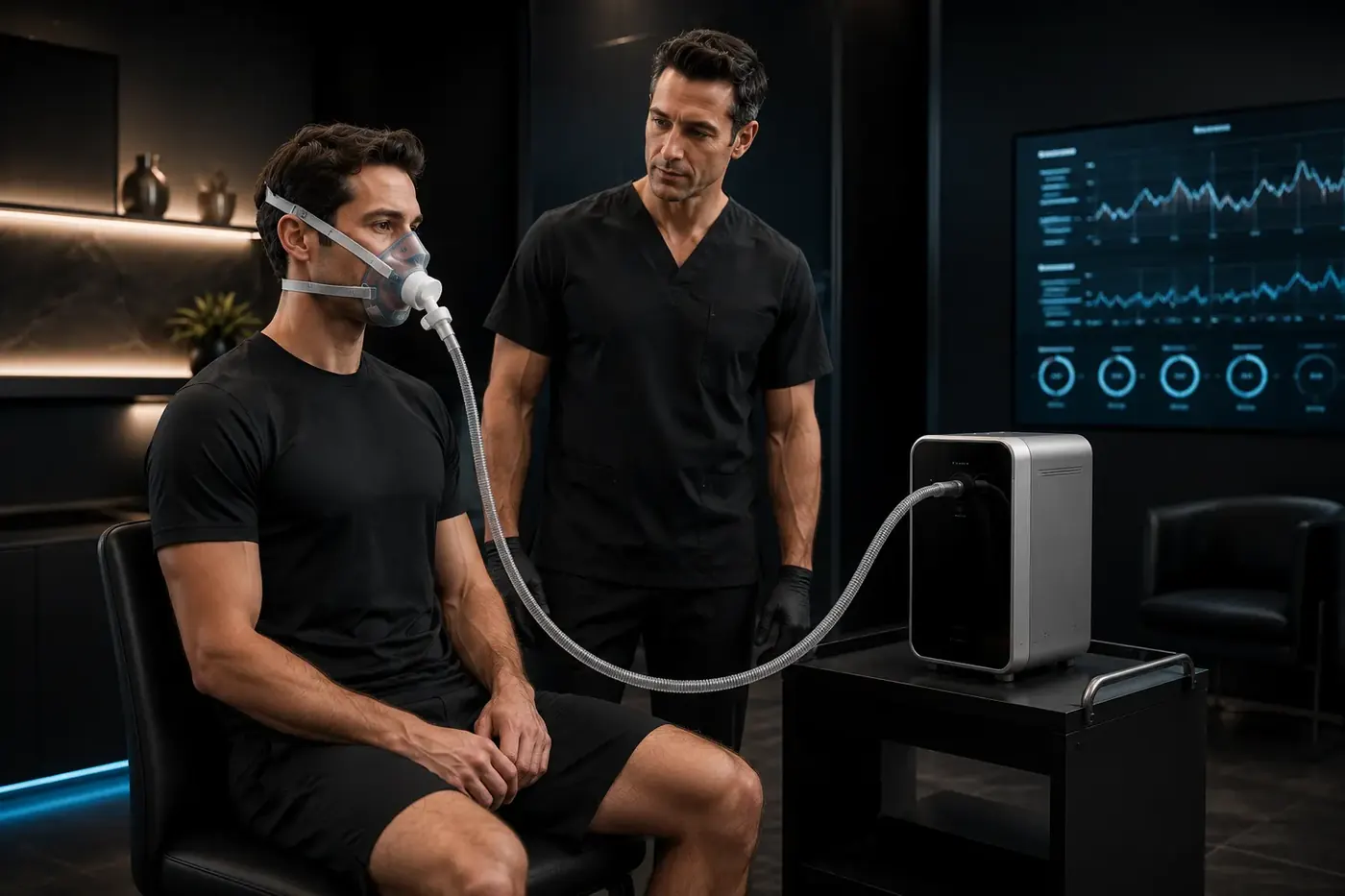
The PNOE metabolic assessment at REMEDY analyzes your breath through a mask to measure how your body uses oxygen and burns fuel, at rest and during exercise. Your clinician reviews the results and uses them to personalize nutrition, training and weight loss decisions. It is non-invasive and performed at the Fort Lauderdale clinic.
Part of the REMEDY® Diagnostic Suite
One of eight assessments behind your Biometrix AI™ blueprint
These assessments can be booked on their own. Combined in the 8-point Diagnostic Suite, the results feed Biometrix AI™ and a physician-reviewed plan covering treatments, peptides, supplements, nutrition and training.
Clinical guide
PNOE: how it works, who it suits and safety
How it works
PNOE is a portable metabolic analyzer that performs indirect calorimetry. You breathe through a soft mask connected to sensors that measure the volume of each breath and its oxygen and carbon dioxide content. Because the body consumes oxygen and releases carbon dioxide in fixed proportions when it burns fat or carbohydrate, those gas measurements reveal how many calories you are using and which fuel they come from.
At rest, the test yields resting metabolic rate and the respiratory exchange ratio, the balance between fat and carbohydrate use. During graded exercise on a treadmill or bike it identifies VO2 peak, a measure of cardiorespiratory fitness that is among the strongest predictors of long-term health, along with the ventilatory thresholds that mark the transition from mainly fat to mainly carbohydrate metabolism and the onset of heavy breathing. Those thresholds define personal heart-rate training zones.
Who it may suit
- Adults beginning a weight-loss program who want a measured calorie target instead of a formula estimate.
- People who are losing weight more slowly than expected and want to know whether metabolism has adapted.
- Athletes and active adults who want training zones based on their own thresholds.
- Patients on longevity plans who want to track cardiorespiratory fitness over time.
When it may not be appropriate
- Unstable angina, a recent heart attack, uncontrolled arrhythmia or severe valve disease, for the exercise test.
- Uncontrolled high blood pressure or asthma.
- Acute illness or fever on the day of testing.
- Pregnancy, for maximal exercise testing.
- Musculoskeletal injuries that prevent safe exercise; the resting test may still be possible.
Medical screening at REMEDY
Care at REMEDY is directed by Remedy's in-house physician, our Medical Director & Lead Physician. Intake, screening and treatment are carried out by registered nurses, APRNs and licensed paramedics working to physician-approved protocols.
A clinician reviews your cardiovascular history, medications such as beta-blockers that alter heart-rate response, and recent symptoms, then records resting vital signs. You are told how to prepare: usually no food or caffeine for several hours and no strenuous exercise for a day beforehand. The exercise stage is supervised and stops when a target is reached, when you ask, or if symptoms appear.
How your imaging session works
A PNOE test is only as good as its preparation, so the protocol is specific: no food for several hours, no caffeine or hard training beforehand, and the same time of day for repeat tests. The resting test is done seated and quiet; the exercise test uses a graded ramp chosen for your fitness and stopped at your limit or at any warning sign. A clinician supervises throughout. The report converts your measured thresholds into heart-rate training zones and a calorie range, which are then used to set nutrition and training targets.
Diagnostics and technology pairing
PNOE and InBody 270 are complementary: one shows how many calories you burn and from what, the other shows what your weight is made of. Together they guide GLP-1 programs, where preserving muscle and metabolic rate is a central concern. Results also inform hormone evaluation when metabolism is unexpectedly low, guide the timing of performance and recovery infusions for athletes, and provide the fitness baseline for a longevity plan.
In clinic or at your location
PNOE testing is performed at the Fort Lauderdale clinic, where the analyzer and exercise equipment are set up. It is not offered as a mobile service. A resting test takes about 15 minutes of measurement; a combined resting and active test, with preparation and review, takes about an hour.
Flagship clinic: 1515 SE 17th St, Suite 119A (The Quay on 17th Street), Fort Lauderdale, FL 33316. Mobile concierge: Standard mobile hours: 9 AM–9 PM daily · Last standard appointment: 6:30 PM · After-hours: by prior arrangement only, not guaranteed · Emergencies: call 911..
Safety and regulatory status
The resting test carries no meaningful risk. Exercise testing carries the same small risks as vigorous exercise, such as lightheadedness, muscle soreness and, rarely, cardiac events in people with underlying heart disease, which is why screening comes first. The mask is cleaned and its filters replaced between clients.
A PNOE assessment provides wellness and performance information. It is not a diagnostic cardiac stress test or pulmonary function test and does not diagnose heart or lung disease. Abnormal responses are referred for medical evaluation.
Payment and financing
Payment options for PNOE: Flexible monthly and split-pay options are available in-office at checkout through Affirm and Klarna, integrated with our clinic checkout. Pre-qualify online, or access patient rewards and treatment financing anytime, in the Remedy App (powered by RepeatMD). Approval and terms are set by each provider, and the cost of your plan is confirmed at your consultation before treatment begins. See financing options.
In depth
PNOE Metabolic Assessment at REMEDY®
- Physician Guided
- Results reviewed in clinical context.
- Evidence Informed
- Responsible interpretation of measured data.
- Personalized Analysis
- A baseline based on your response.
- Concierge Experience
- Private, calm, and educational care.
Discovery Before Optimization
Know Your Body Before You Optimize It.
Generic calculators and population averages can be useful starting points, but they cannot fully explain how one individual uses oxygen, expends energy, or responds to a specific testing protocol.
PNOĒ provides objective respiratory data. REMEDY® places those findings within the larger context of your health history, medications, activity, nutrition, goals, recovery, and lifestyle.
The value is not an isolated score. It is the physician-guided conversation that follows: what the data may mean, what it does not establish, which findings matter most, and what next steps may be appropriate.
Discovery before recommendation
Data placed in clinical context
Education before treatment
Measured Insight
Why Guess When You Can Measure?
Indirect calorimetry adds objective respiratory information to the conversation. It does not make testing perfect, but it provides a more individualized reference point than generalized estimates alone.
Estimated Approach
Built From Averages
Useful for general guidance, but primarily based on population equations and broad assumptions.
- Population-based formulas
- Wearable estimates
- Generic calorie targets
- Fixed exercise zones
Measured Approach
Built From Your Response
Respiratory data is gathered during the selected protocol and interpreted within your clinical and lifestyle context.
- Individual respiratory data
- Protocol-specific findings
- Physician-guided interpretation
- More informed recommendations
Respiratory Gas Analysis
What PNOĒ Measures.
PNOĒ uses breath-by-breath indirect calorimetry. The available findings depend on the selected protocol, data quality, and the clinical purpose of the assessment.
Metabolic Baseline
Resting Metabolism
A standardized resting assessment can estimate resting energy expenditure and provide a more individualized baseline than a generic calorie equation.
VO₂
Oxygen Utilization
Oxygen consumption reflects how much oxygen the body uses over time and helps characterize aerobic demand during the selected protocol.
VCO₂
Carbon Dioxide Production
Carbon dioxide production contributes to respiratory analysis and helps describe metabolic response alongside oxygen consumption.
Energy Demand
Energy Expenditure
Measured VO₂ and VCO₂ can be used to estimate energy use during the specific resting or activity-based protocol performed.
Respiratory Exchange
Fuel Utilization
Under appropriate testing conditions, respiratory exchange data may provide insight into the relative contribution of fat and carbohydrate use.
Active Response
Exercise Response
When an appropriate active protocol is used, testing may help characterize physiological transitions and training intensity.
The Assessment Experience
A Clearer View of How Your Body Uses Energy.
During the assessment, you wear a fitted breathing mask while completing the approved resting or activity-based protocol. Your results are then reviewed in context—not delivered as isolated numbers.
Clinical Intake
Review goals, health history, medications, activity, and assessment suitability.
Breath Analysis
Complete the approved resting or activity-based protocol with a fitted mask.
Results Review
Data is reviewed for quality and interpreted under the conditions tested.
Personalized Next Steps
Findings may help inform discussions around nutrition, exercise, recovery, weight management, and follow-up care.
What To Expect
- Noninvasive breath analysis
- Calm, private environment
- Protocol matched to the individual
- Physician-guided interpretation
- Clear next-step recommendations
From Measurement To Meaning
How Results Guide Personalized Care.
Metabolic data is one component of a broader clinical picture. When appropriate, findings may help inform conversations across several areas of personalized wellness.
Nutrition
More Informed Fueling
Measured resting energy and respiratory patterns may help inform calorie and fueling discussions alongside your history and goals.
Weight Management
Individualized Baselines
A measured metabolic baseline can support planning, progress review, and education within a broader medical program.
Performance
Exercise Insight
Active testing may help characterize oxygen use, exercise demand, and physiological transitions when the selected protocol supports them.
Recovery
Smarter Progression
Results can provide context for balancing conditioning, training intensity, recovery demands, and future reassessment.
Hormone Optimization
Additional Context
Metabolic findings may contribute context, while hormone decisions still require symptoms, clinical evaluation, and laboratory testing.
Longevity
Long-Term Baselines
A measurable baseline may support a more informed long-term wellness strategy when integrated with broader clinical information.
Individualized Discovery
Who May Benefit Most?
PNOĒ may be valuable for individuals seeking a more objective starting point before making decisions about nutrition, fitness, recovery, weight management, or long-term wellness.
Busy Professionals
For individuals who want focused, measurable guidance that can be integrated into demanding schedules.
Athletes & Active Adults
For people seeking a more individualized view of exercise demand, oxygen use, conditioning, and training intensity.
Weight-Management Patients
For patients who may benefit from a measured resting-energy baseline within a broader physician-guided strategy.
Longevity-Focused Clients
For those establishing measurable physiological baselines as part of a thoughtful long-term plan.
Executive Wellness Clients
For clients seeking premium assessment, clear education, and coordinated recommendations.
Data-Driven Individuals
For people who prefer decisions informed by measured physiology rather than estimates alone.
Evidence Snapshot
Clinical Evidence With Responsible Boundaries.
Published research supports selected PNOĒ respiratory measurements under defined study conditions. The evidence should be communicated accurately without extending device validation to every software-generated score or clinical conclusion.
Published validation research found that PNOĒ respiratory gas measurements closely agreed with a validated stationary metabolic cart for VO₂, VCO₂, ventilation, and respiratory quotient during controlled cycling in healthy adults.
Results were specific to the tested protocols and conditions.
Participants in the validation study were healthy adults.
Validation of respiratory variables does not automatically validate every proprietary score.
Reliable interpretation depends on calibration, standardization, data quality, and clinical context.
Selected Research
Validity and Reliability of the New Portable Metabolic Analyzer PNOĒ Critical Power and Ventilatory Threshold Context Applied Exercise Energy Expenditure Research Portable Indirect Calorimetry in Dynamic Activity Gas-Exchange Dynamics and Individualized Modeling
What to expect
01. Book your assessment
Schedule online or by phone and receive simple preparation instructions.02. Testing
The assessment is non-invasive and performed at the Fort Lauderdale clinic.03. Results review
Your clinician walks you through the findings in plain language.04. Plan
Results inform a personalized plan, with repeat testing to measure progress.
In-clinic technology
The REMEDY® technology suite
PNOE Metabolic Assessment FAQs
What is the difference between the resting and active PNOE tests?
The resting test measures metabolic rate and fuel use while you sit or lie quietly. The active test adds graded exercise to measure VO2 peak and training thresholds.
How should I prepare for a PNOE test?
Typically avoid food and caffeine for several hours and hard exercise for a day beforehand, and wear exercise clothing for the active test. You receive exact instructions when you book.
Is PNOE accurate?
Indirect calorimetry is the standard method for measuring metabolic rate, and the device has been compared against laboratory metabolic carts in published validation studies. Following the preparation instructions matters for reliable results.
What is a PNOĒ metabolic assessment?
PNOĒ is a breath-based metabolic assessment using indirect calorimetry. It measures respiratory gas exchange during an approved resting or activity-based protocol.
What does indirect calorimetry measure?
It measures the oxygen you use and the carbon dioxide you produce. Those values can be used to estimate energy expenditure and characterize respiratory response under the conditions tested.
What is resting metabolic rate?
Resting metabolic rate is the energy your body uses while at rest to support essential functions such as breathing, circulation, temperature regulation, and cellular activity.
Is the assessment painful?
The breath analysis itself is noninvasive. You wear a fitted breathing mask, and the team allows time for adjustment.
Do I need to be an athlete?
No. The assessment pathway should be selected according to your health status, goals, current ability, and clinical screening.
Will I have to exercise to exhaustion?
Not necessarily. Some assessments are resting or submaximal. The selected protocol depends on the purpose of testing and provider judgment.
How should I prepare?
Preparation varies by protocol. The clinic will provide specific guidance regarding food, caffeine, exercise, nicotine, alcohol, hydration, medications, and clothing.
Can the test tell me exactly how many calories to eat?
A resting assessment can provide a measured energy baseline, but daily calorie needs also depend on activity, goals, body composition, health status, and progress.
Can it identify my fat-burning zone?
Under appropriate conditions, respiratory data may help identify an intensity range where measured fat oxidation is relatively high. That range is protocol-specific and does not guarantee long-term fat loss.
Can PNOĒ help with weight-management planning?
It may provide an individualized resting-energy baseline and additional context for nutrition and exercise discussions within a broader medical strategy.
Does the assessment diagnose a slow metabolism?
No. It measures energy expenditure and respiratory patterns under the testing conditions. It does not independently diagnose the cause of a high or low metabolic rate.
Will I receive a personalized plan?
Your results may help inform personalized recommendations when combined with your goals, history, activity, nutrition, medications, and other relevant clinical information.
How accurate is PNOĒ?
Published research found close agreement between selected PNOĒ respiratory measurements and a validated stationary metabolic cart during controlled cycling in healthy adults. Accuracy still depends on calibration, mask fit, preparation, and protocol quality.
When should metabolic testing be repeated?
Retesting may be useful after meaningful changes in weight, training status, nutrition, health, medication, or treatment progress—when the result is likely to influence the plan.
Is PNOĒ a replacement for laboratory testing or medical evaluation?
No. PNOĒ is one source of physiological information and does not replace medical evaluation, laboratory testing, or diagnostic cardiopulmonary testing when those are clinically indicated.
Related treatments
- Physician-Guided GLP-1 Medical Weight LossA physician-supervised weight loss program that starts with a medical evaluation, then builds a monitored plan around clinical eligibility.
- InBody 270 Body Composition AnalysisA quick, non-invasive scan that reports muscle, fat and body water so progress is measured, not guessed.
- TRT & Hormone Optimization (HRT)Lab-guided testosterone and hormone replacement overseen by a licensed physician, with ongoing monitoring.
From the journal
All articles →- Diagnostics & LongevityWhy Am I So Tired Even When My Bloodwork Is “Normal”? What to Test NextA normal basic lab panel can be reassuring, but it does not evaluate every possible reason for persistent fatigue. Sleep quality, iron stores, thyroid…
- Diagnostics & LongevityWhy Am I Always Tired? 7 Possible Causes of Persistent FatigueUnderstanding what your body may be telling you when rest is no longer enough.
- Diagnostics & LongevityExecutive Physicals in Fort Lauderdale: What’s Included and Who Should Consider One?An executive physical is designed to create a broader picture of your health than a rushed problem-focused visit. The exact testing should be…
Financing
Flexible Payment & Financing Options
In-Office BNPL Financing
Flexible monthly and split-pay options are available in-office at checkout through Affirm and Klarna, integrated with our clinic checkout.
RepeatMD Rewards & Financing
Pre-qualify online, or access patient rewards and treatment financing anytime, in the Remedy App (powered by RepeatMD).
Subject to approval by the financing provider. Medical evaluation required. Treatment based on eligibility.
Physician evaluation: All treatments require an evaluation by a licensed clinician. Eligibility, prescriptions and treatment plans are determined by a licensed physician. Individual results vary.
Regulatory status: Assessments provide wellness and planning information. They are not a substitute for diagnostic testing ordered to diagnose a medical condition.
Start with a conversation
Book at our Fort Lauderdale clinic, or request mobile care across South Florida: Broward, Miami-Dade and Palm Beach counties.
Medical evaluation required. Treatment based on eligibility.