Recovery & Performance
VO₂ Max Testing in Fort Lauderdale: What It Tells You About Fitness, Metabolism & Longevity
What Your Aerobic Capacity Can Reveal About Fitness, Metabolism & Longevity
Published · 12 min read · The Remedy IV Health + Wellness
Medically reviewed by Dr. Jarrod Wilson, MD (FL License ME133911) ·
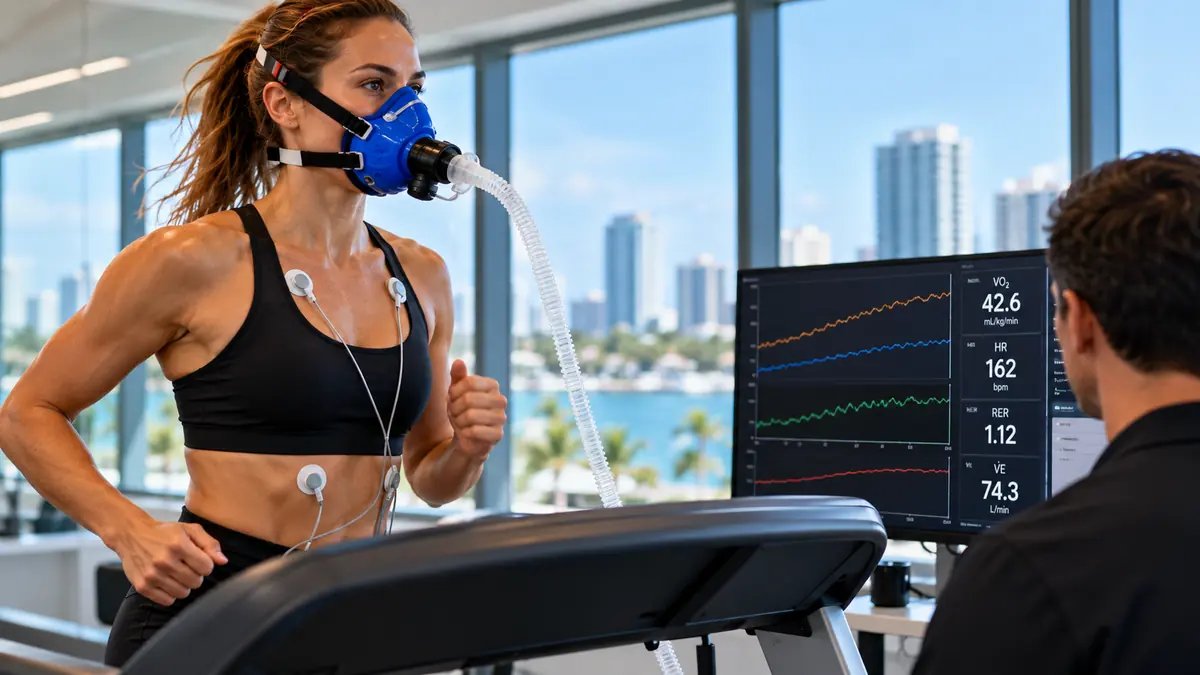
VO₂ max testing measures how effectively your body takes in, transports, and uses oxygen during progressively harder exercise. More than an athlete’s performance number, cardiorespiratory fitness can provide meaningful context about cardiovascular capacity, metabolic performance, exercise prescription, and long-term health.
A direct metabolic exercise assessment can provide substantially more individualized information than relying only on age-based heart-rate formulas or a fitness wearable estimate.
Featured Answer
What Does VO₂ Max Testing Tell You?
VO₂ max is a measure of cardiorespiratory fitness—the maximum rate at which your body can use oxygen during intense exercise. Testing can help quantify aerobic capacity, establish a fitness baseline, identify individualized training intensities, and show how efficiently the heart, lungs, circulation, and working muscles function together. Cardiorespiratory fitness is also strongly associated with long-term health outcomes, although a VO₂ max result is not, by itself, a diagnosis or a prediction of lifespan.
Key Takeaways
VO₂ Max Is More Than A Fitness Score.
Aerobic Capacity
VO₂ max quantifies your ability to take in and use oxygen during demanding exercise, making it one of the most useful measurements of cardiorespiratory fitness.
Personalized Training
Gas-exchange testing can provide individualized information about exercise intensity and physiological thresholds rather than relying exclusively on generic heart-rate zones.
Long-Term Health
Higher cardiorespiratory fitness is consistently associated with better cardiovascular and all-cause health outcomes across large observational studies.
What You'll Learn
A Better Look At Your Physiology.
What VO₂ Max Actually Measures
Understand what oxygen consumption tells us about the integrated performance of your cardiovascular, respiratory, circulatory, and muscular systems.
How Testing Works
Learn what happens during a graded metabolic exercise assessment and why measuring respiratory gases is different from simply tracking heart rate.
Fitness & Metabolism
See how oxygen use, workload, fuel utilization, and exercise intensity fit into a more personalized picture of metabolic performance.
Fitness & Longevity
Understand why cardiorespiratory fitness has become an important health marker—and why it still needs to be interpreted alongside the rest of your clinical picture.
Foundational Education
What Is VO₂ Max?
VO₂ max stands for maximal oxygen uptake. It represents the greatest amount of oxygen your body can use during strenuous exercise and is commonly expressed in milliliters of oxygen per kilogram of body weight per minute (mL/kg/min).
The number reflects a coordinated physiological process. Your lungs must move oxygen into the bloodstream. Your heart must pump oxygenated blood. Blood vessels must deliver it to working tissue. Your muscles must then extract and use that oxygen to generate energy.
For that reason, VO₂ max is not simply a measurement of how strong your lungs are or how fast your heart can beat. It reflects the integrated capacity of multiple systems working together.
The American Heart Association has described cardiorespiratory fitness as an important clinical health marker because lower fitness is associated with increased cardiovascular and all-cause mortality risk.
Absolute vs. Relative VO₂ Max
Oxygen consumption can be expressed as an absolute value, usually liters per minute, or relative to body mass. The relative value makes it easier to compare aerobic capacity between people of different sizes, but body composition matters. A change in body weight can alter relative VO₂ max even when absolute aerobic capacity changes less dramatically.
Clinical Insight
A VO₂ max number should not be interpreted in isolation. Age, sex, body size, body composition, training history, medications, health conditions, test protocol, and whether a true maximal effort was reached can all influence interpretation. The value becomes more useful when it is placed in context.
The Testing Experience
How VO₂ Max Testing Works.
A direct VO₂ assessment generally uses a treadmill or stationary cycle with a mask or mouthpiece that measures the gases you breathe. As exercise intensity gradually increases, the system analyzes oxygen consumption, carbon dioxide production, ventilation, workload, and related physiological responses.
A comprehensive cardiopulmonary exercise test may also monitor heart rhythm, blood pressure, oxygen saturation, symptoms, and other clinical variables. As Cleveland Clinic explains, cardiopulmonary exercise testing evaluates how the heart and lungs respond to exercise while measuring respiratory gases.
Establish Baseline Data
Resting information and relevant health or exercise history provide context before workload begins to rise.
Increase Workload
Speed, incline, or cycling resistance increases progressively while breathing and physiological responses are measured.
Interpret The Response
The resulting data can help characterize aerobic capacity, exercise intensity, thresholds, and areas that may deserve additional attention.
Is A Wearable VO₂ Max Estimate The Same Thing?
No. Many watches and fitness devices estimate VO₂ max using heart rate, pace, movement, demographics, and proprietary algorithms. Those estimates can be useful for following trends, particularly when measurements are collected consistently, but they do not directly measure respiratory gas exchange.
A laboratory or clinic-based metabolic assessment measures oxygen and carbon dioxide from your breath during exercise. That distinction matters when the goal is a more individualized physiological assessment.
Performance Physiology
What VO₂ Testing Can Reveal About Fitness.
Two people can perform similar workouts while experiencing very different physiological stress. Age-based formulas and generic training zones cannot fully account for individual fitness, medications, training history, genetics, or metabolic response.
Direct metabolic testing can help create a more individualized starting point.
Aerobic Fitness Baseline
A measured baseline gives you something objective to compare with future testing after changes in training, health, body composition, or lifestyle.
Exercise Intensity
Gas-exchange data can help identify transitions in exercise intensity that may be more individualized than broad percentage-of-max-heart-rate formulas.
Training Progress
Repeat testing can show whether physiological capacity is changing even when body weight, appearance, or wearable scores tell an incomplete story.
For active adults, athletes, and high-output professionals, VO₂ data can complement a broader recovery and performance strategy that also considers sleep, nutrition, hydration, strength, training load, stress, and recovery capacity.
Metabolic Context
What Does VO₂ Testing Tell You About Metabolism?
Exercise metabolism is fundamentally about producing energy. At lower workloads, the body can generate much of that energy aerobically, using oxygen while drawing from a mixture of fat and carbohydrate. As intensity rises, carbohydrate contribution generally increases and physiological demands change.
Advanced metabolic testing can examine oxygen consumption and carbon dioxide production across different workloads. Depending on the equipment and protocol, this information may help characterize energy expenditure, fuel utilization, ventilatory thresholds, and the transition from easier sustainable work toward higher-intensity exercise.
This can be valuable for someone trying to train more intelligently, but it is important not to confuse exercise metabolism with a complete metabolic health assessment.
VO₂ Max Does Not Diagnose Your Entire Metabolism
A VO₂ max result cannot tell you whether you have insulin resistance, diabetes, thyroid disease, abnormal cholesterol, hormonal dysfunction, or another metabolic condition. Those questions require appropriate history, examination, and laboratory evaluation.
For a broader view, physicians may consider VO₂ or metabolic exercise information alongside blood pressure, body composition, glucose-related markers, lipids, symptoms, family history, medications, and other clinically relevant data. Our guide to metabolic health blood markers explains why no single measurement provides the entire picture.
Know Your Body Before You Optimize It
The purpose of metabolic testing should not be to generate more numbers. It should answer a useful question. When testing is connected to your goals, health history, training habits, and other clinical information, the data can become actionable rather than simply interesting.
Longevity Science
Why Cardiorespiratory Fitness Matters For Long-Term Health.
One reason VO₂ max has moved beyond sports laboratories is the strong relationship between cardiorespiratory fitness and health outcomes.
Large observational studies consistently show that people with greater cardiorespiratory fitness tend to have lower rates of cardiovascular disease and premature mortality. The American Heart Association has argued that cardiorespiratory fitness provides meaningful health-risk information beyond many conventional risk factors.
That does not mean a VO₂ max test predicts exactly how long you will live. Longevity is influenced by genetics, blood pressure, tobacco exposure, glucose regulation, cholesterol, body composition, sleep, mental health, socioeconomic factors, medical care, physical activity, strength, and many other variables.
VO₂ max is better viewed as one measurable dimension of physiological capacity.
Fitness Is Modifiable
Unlike chronological age, cardiorespiratory fitness can often improve with appropriately prescribed aerobic exercise. The Physical Activity Guidelines for Americans recommend that most adults accumulate 150 to 300 minutes of moderate-intensity aerobic activity each week, or an equivalent amount of vigorous activity, while also performing muscle-strengthening exercise on at least two days.
The appropriate starting point varies. Someone who has been sedentary, has cardiovascular risk factors, experiences exertional symptoms, or has a significant medical history may need clinical evaluation before beginning vigorous exercise.
Evidence Snapshot
Cardiorespiratory fitness has a strong inverse association with adverse health outcomes, but most longevity evidence is observational. Higher fitness is a valuable health marker—not proof that maximizing one number will prevent disease or extend an individual person's lifespan. The goal should be sustainable improvement within a complete health strategy.
Readers interested in the larger healthy-aging picture can explore our evidence-informed guide to longevity and biohacking and REMEDY®'s physician-guided longevity services in Fort Lauderdale.
Who May Benefit
VO₂ Testing Isn't Only For Elite Athletes.
Active Adults
People who want objective feedback about aerobic fitness and a clearer baseline for improving cardiovascular capacity.
Endurance Athletes
Runners, cyclists, triathletes, and other endurance-focused athletes may use metabolic data to refine training intensity and monitor adaptation.
Longevity-Focused Adults
People interested in measuring cardiorespiratory fitness as one component of a broader preventative and healthy-aging strategy.
People Returning To Fitness
A baseline may help quantify current capacity before a structured exercise program, assuming vigorous testing is medically appropriate.
Performance-Minded Professionals
Busy adults who want more objective information about conditioning rather than relying solely on subjective effort or wearable metrics.
Data-Driven Wellness Clients
People who want exercise data interpreted alongside other diagnostics rather than chasing isolated wellness scores.
Risks & Limitations
What VO₂ Max Cannot Tell You.
VO₂ testing is powerful because it measures a specific physiological capability. It becomes misleading when that capability is treated as a complete health assessment.
It Does Not Replace Cardiovascular Screening
A high VO₂ max does not prove that someone is free of coronary disease, arrhythmias, structural heart disease, hypertension, or other cardiovascular problems. Symptoms such as chest pain, fainting, unexplained shortness of breath, or palpitations require appropriate medical evaluation.
It Does Not Replace Strength Or Body Composition
Aerobic capacity is only one component of physical fitness. Muscular strength, power, mobility, balance, and body composition also influence health, function, and healthy aging.
It Does Not Replace Laboratory Testing
VO₂ max cannot determine cholesterol levels, glucose regulation, nutrient status, hormone levels, kidney function, liver function, or other laboratory biomarkers.
Maximal Testing Is Physically Demanding
A true maximal exercise assessment intentionally pushes exercise intensity upward. People with known cardiovascular or pulmonary disease, significant risk factors, concerning symptoms, pregnancy, recent illness or injury, or other medical considerations may require clearance or a modified testing approach.
Myth
The Higher Your VO₂ Max, The Longer You Will Live
VO₂ max is associated with long-term health outcomes, but it cannot predict an individual's lifespan and should not be treated as a longevity guarantee.
Fact
Cardiorespiratory Fitness Is An Important Modifiable Health Marker
Improving aerobic fitness through appropriate physical activity can support cardiovascular health, functional capacity, metabolic health, and overall physical resilience.
Using Your Results
What Should You Do With A VO₂ Max Result?
The most useful test is one that changes what you do next.
If aerobic capacity is lower than expected, the appropriate response is not necessarily to begin extreme high-intensity training. A better strategy may involve gradually increasing aerobic volume, improving consistency, addressing recovery, building strength, evaluating symptoms or risk factors, and then retesting after enough time has passed for adaptation.
If your VO₂ max is already high, the goal does not have to be endlessly pushing it higher. Training may instead prioritize maintaining aerobic capacity while improving strength, mobility, body composition, sport-specific performance, or recovery.
Repeated testing can be particularly useful when performed under similar conditions. Trends can help show whether your training strategy is producing the physiological adaptation you intended.
Physician-Guided Perspective
Optimization should begin with a question, not a treatment. Are you trying to improve endurance? Better understand unexplained exercise limitations? Establish a longevity baseline? Improve metabolic health? A physician-guided approach can determine which data are actually useful and whether additional evaluation is appropriate.
People Also Ask
Common Questions About VO₂ Max.
What is a good VO₂ max for my age?
A “good” value depends on age, sex, body size, test method, and the reference population being used. Rather than chasing one universal target, compare results with appropriate reference data and your own previous measurements.
Can VO₂ max improve after age 40 or 50?
Yes. Cardiorespiratory fitness remains trainable throughout adulthood. The magnitude of improvement varies according to baseline fitness, health, genetics, exercise dose, consistency, and recovery.
Does walking improve VO₂ max?
Brisk walking can improve cardiorespiratory fitness, particularly in sedentary or less-fit individuals. As fitness increases, greater intensity, duration, incline, or other progressive overload may be needed to continue improving.
Is VO₂ max more important than resting heart rate?
They measure different things. Resting heart rate can provide useful cardiovascular and recovery context, while VO₂ max more directly characterizes aerobic capacity. Neither should be treated as a complete measure of health.
Frequently Asked Questions
VO₂ Max Testing FAQ.
Testing should be selected and interpreted according to your health status, goals, and the type of information you actually need.
What exactly does VO₂ max measure?
VO₂ max measures the maximum rate at which your body can consume and use oxygen during strenuous exercise. It is a widely used measure of cardiorespiratory fitness.
How long does a VO₂ max test take?
The exercise portion is usually relatively brief, but total appointment time varies depending on preparation, baseline measurements, protocol, recovery monitoring, and whether additional metabolic or clinical measurements are included.
Do I have to be an athlete to get tested?
No. VO₂ testing can be useful for recreational exercisers, active adults, people establishing a fitness baseline, and longevity-focused patients as well as competitive athletes.
Is VO₂ max testing safe?
Exercise testing is commonly performed safely when the protocol and supervision are appropriate for the individual. Because maximal testing is strenuous, health history, symptoms, cardiovascular risk, medications, and other factors may affect whether testing is appropriate.
Can my Apple Watch or fitness tracker measure VO₂ max?
Wearables generally estimate VO₂ max from variables such as heart rate, pace, movement, and demographic information. They do not directly measure respiratory oxygen and carbon dioxide exchange in the same way as metabolic exercise testing.
How often should VO₂ max be retested?
There is no universal schedule. Retesting may be useful after a meaningful training period or major change in fitness strategy. Testing too frequently may produce data without enough time for meaningful physiological adaptation.
Can losing weight increase my relative VO₂ max?
Because relative VO₂ max is adjusted for body weight, weight loss can influence the reported value. That is one reason results should be interpreted alongside absolute oxygen consumption, body composition, training changes, and overall clinical context.
Is VO₂ max a longevity test?
Not by itself. Cardiorespiratory fitness is strongly associated with long-term health outcomes, making VO₂ max relevant to longevity-focused assessment. But healthy aging depends on many factors, and no single fitness metric can determine biological age or predict lifespan.
The Bigger Picture
Measure What Matters—Then Put It In Context.
VO₂ max testing can transform an abstract idea like “cardio fitness” into an objective physiological measurement. For an athlete, that can support more precise training. For an active adult, it can establish a baseline. For someone focused on longevity, it can add another meaningful dimension to a broader assessment of cardiovascular and metabolic health.
But the number is not the destination.
Blood pressure, laboratory markers, body composition, muscular strength, sleep, nutrition, exercise habits, symptoms, medical history, medications, and family history may all matter when building a more complete picture of health.
That is consistent with REMEDY® Health + Wellness approach: know your body before you optimize it. Advanced diagnostics are most valuable when they help answer a real question and guide a responsible next step.
Explore REMEDY®'s broader physician-guided wellness services or learn more about our approach to performance and longevity optimization in Fort Lauderdale.
This article is for general education and is not medical advice. All treatments require an evaluation by a licensed clinician. Eligibility, prescriptions and treatment plans are determined by a licensed physician. Individual results vary. For emergencies, call 911.
Topic guides